

Oral Surgery
Surgical Dentistry at the Highest Level in Berlin
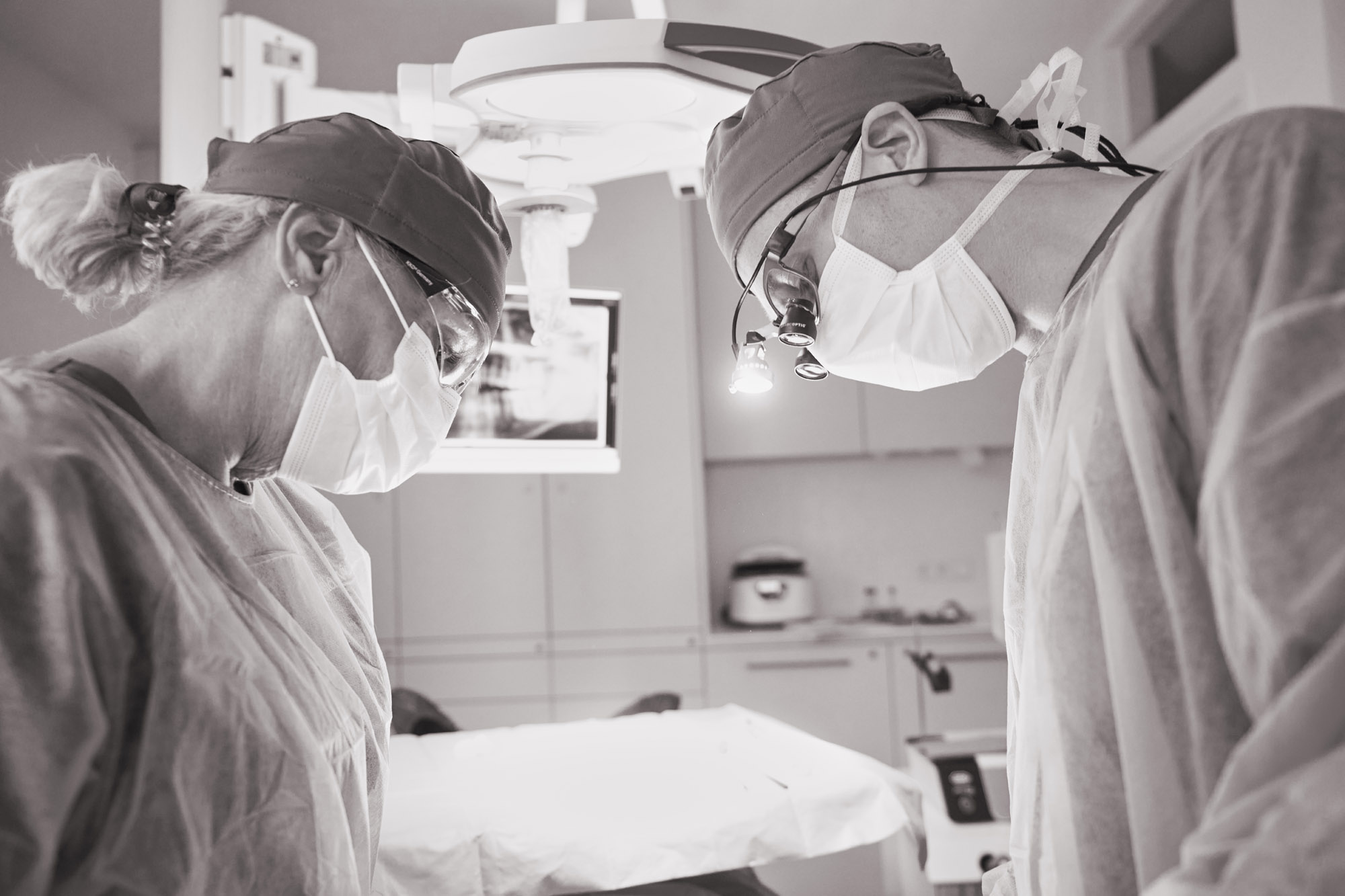
Oral surgery encompasses surgical procedures in the area of the teeth, the jaw, and adjacent soft tissues—from tooth extraction to complex reconstructive measures. As specialist dentists for oral surgery, Dr. Esther Kluk & Colleagues at IMPLA·VIO in Berlin-Friedenau offer you the complete spectrum of outpatient oral surgical care.
Among the most common procedures is wisdom tooth removal as preparation for orthodontic treatment or to prevent tooth displacement, inflammation, or pressure pain in the jaw. In cases of persistent root canal inflammation, a root tip resection can often preserve the tooth. Cyst removal is performed for changes in the teeth, the jaw, or salivary glands. For oral mucosal changes, we examine unclear mucosal findings, perform biopsies, and remove benign growths.
Individually Planned Procedures Under Gentle Anesthesia
Preparatory measures for dental prosthetics or orthodontic therapies are also part of our spectrum, such as the exposure of impacted or displaced teeth or plastic-surgical corrections of the alveolar ridge. All procedures are performed under local anesthesia, and upon request also with additional intravenous sedation or under general anesthesia. We collaborate closely with an experienced team of anesthesiologists—for maximum safety and the most relaxed treatment situation possible.
What is the difference between a dentist and oral surgery?
A dentist often treats diseases of the teeth, gums, and oral cavity conservatively, for example with fillings, root canal treatments, or dentures. Oral surgery becomes necessary when a surgical procedure is required – for instance for a complex tooth extraction, an impacted tooth, or a cyst. As a specialist dentist in oral surgery, Dr. Esther Kluk at IMPLA·VIO also treats demanding surgical findings. If needed, procedures can be performed under sedation or general anesthesia.
What falls under oral surgery?
Oral surgery includes surgical treatments of the teeth, jawbone, and adjacent soft tissues. This includes, for example, tooth extractions, wisdom tooth removal, apicoectomy, cyst removal, tooth exposure, and pre-prosthetic procedures. At IMPLA·VIO, such treatments are carefully diagnosed and surgically planned – from routine removal to complex reconstruction, always tailored to the anatomical situation.
What is the difference between an oral surgeon and a maxillofacial surgeon?
Both specialties work surgically, but their training focus differs. Oral surgeons are specialist dentists for surgical procedures on the teeth, jaw, and oral mucosa. Oral and maxillofacial surgeons also have medical training and treat more extensive diseases and injuries of the face, jaws, and neck. For many dentoalveolar – i.e., procedures involving the teeth and the tooth-bearing jaw area – oral surgery specialization, as at IMPLA·VIO, is the right place to go.
When should you see an oral surgeon?
Not every complaint requires a surgical procedure. An oral-surgical assessment is advisable if a tooth does not erupt properly, recurrent inflammation occurs, a root canal treatment does not heal, a cyst is suspected, or a tooth needs to be prepared for dentures or orthodontic treatment. An examination may also be indicated for unclear changes in the oral mucosa. IMPLA·VIO clarifies which procedure is actually necessary.
How much does it cost to have a wisdom tooth removed?
The removal of a wisdom tooth does not have a fixed price. Key factors are its position, the number of teeth to be treated, proximity to important structures, and the surgical effort involved. A simple removal is assessed differently than a tooth that lies deep in the bone or is impacted. If removal is medically necessary, statutory health insurance generally covers standard wisdom tooth removal, including wound care and follow-up. Decisive for the procedure are the position of the tooth, its proximity to important structures, and the surgical effort. At IMPLA·VIO, treatment is carefully planned using modern imaging. Additional services such as sedation or general anesthesia are discussed with you in advance and, if applicable, billed separately. Private insurers review coverage based on your individual policy.
How many days of rest do you need after wisdom tooth surgery?
After an uncomplicated wisdom tooth removal, many patients are back to everyday life after just a few days. However, sports and physical exertion should be paused at first to avoid secondary bleeding and increased swelling. On the day of treatment, soft, non-hot foods are recommended. Alcohol and smoking should be avoided during the initial healing phase, as they can impair wound healing. How much rest is needed depends on the procedure and individual healing. At IMPLA·VIO, our specialist dentists in oral surgery will give you specific instructions for your aftercare.
How much does an apicoectomy cost?
An apicoectomy is often used to preserve a tooth when inflammation persists despite root canal treatment or anatomical factors make repeat treatment more difficult. For patients with statutory insurance, the health insurance fund generally covers the procedure if the tooth is considered worth preserving and the medical requirements are met. At IMPLA·VIO, treatment is carefully planned with modern imaging. We will inform you in advance about possible private add-on services and your individual cost framework.
When is a cystectomy performed?
A cyst can go unnoticed for a long time and still grow larger, displace neighboring structures, or promote inflammation. A cystectomy is recommended when the lesion should be removed completely – often in the area of the jawbone, a tooth, or adjacent soft tissues. At IMPLA·VIO, the findings are assessed using modern 3D imaging and the procedure is planned precisely. The goal is complete removal while protecting the surrounding tissue as much as possible.
Tooth Extraction
If a tooth is severely damaged, deeply fractured, or inflamed, tooth extraction (dental extraction) may be medically necessary. In our practice in Berlin-Friedenau, we also perform more complex surgical tooth extractions – safely, gently, and with many years of experience.
Wisdom Tooth Extraction
Wisdom teeth develop later than other teeth, and there is not always enough room for them in the jaw. In many cases, wisdom teeth remain fully or partially trapped in the bone and only partially erupt through the gums.

Root-End Surgery
During an apicoectomy (root end surgery), the inflamed tip of a tooth root is surgically removed. This prevents bacteria from spreading to the jawbone and causing bone loss and tooth loss.
Pre-prosthetic surgery
For dentures to fit reliably and last a long time, the surrounding tissue must be optimally prepared.
Cyst Removal
Cysts in the jaw, mucous membrane, or salivary glands often go unnoticed for a long time because they initially do not cause any symptoms. If left untreated, however, they can increase in size, displace surrounding structures, or cause inflammation.

Changes in the Oral Lining
Changes in the oral mucosa occur frequently – ranging from harmless irritation and benign growths to precancerous lesions requiring treatment or, rarely, malignant changes. To clarify uncertain findings, we perform a biopsy or a trial excision (surgical removal) at our oral surgery practice in Berlin-Friedenau.